
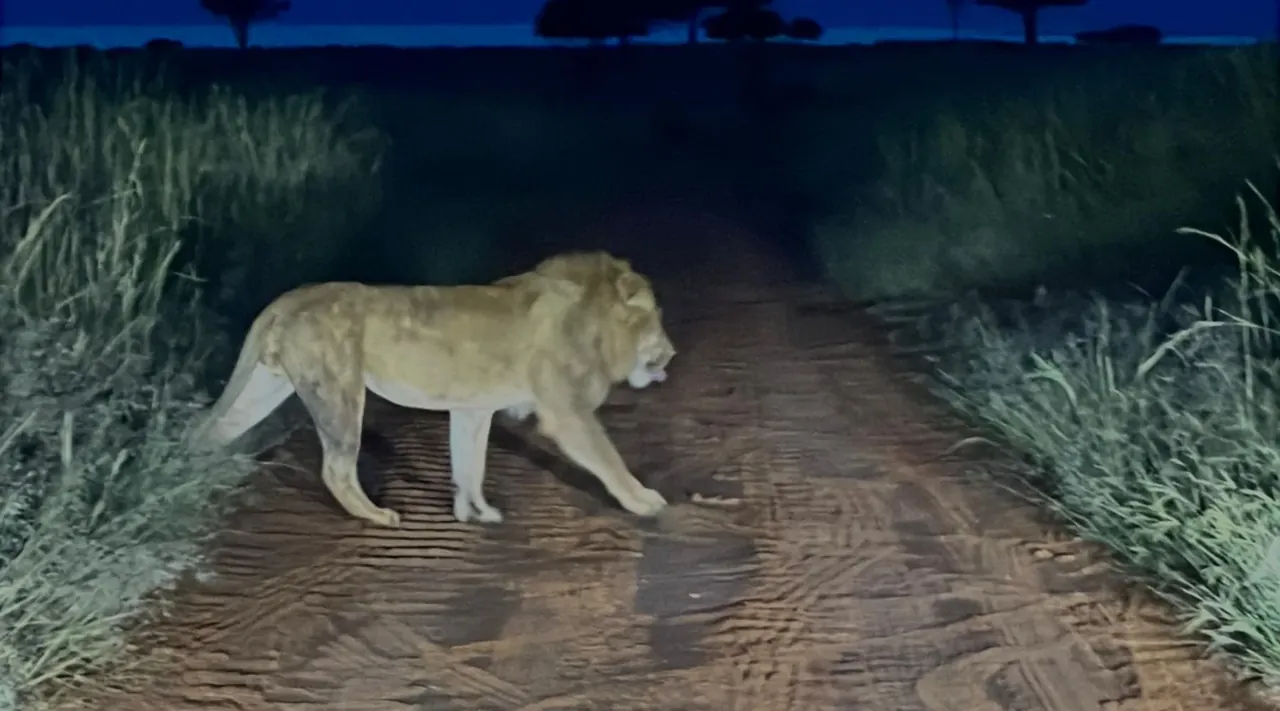
There is a different Uganda waiting after sunset. In the afternoon, the savannah feels open and legible: lions lie beneath trees, elephants work steadily between feeding grounds and Uganda kob graze across the plains. Then the heat softens, the last light slips behind the grasslands and the country begins to keep some of its secrets.
Birds settle into the trees. The daytime animals become less visible. Beyond the reach of the vehicle, another world begins to move. A night game drive is not simply a daytime safari with a later start; it asks you to watch and listen in a different way. When a spotlight catches a pair of reflective eyes in the distance, the whole vehicle seems to pause with them.
The savannah changes after dark
In daylight, wildlife can often be seen from far across the plains. At night, the world draws closer. Your guide works slowly, following a track with the spotlight and reading the smallest signs: a shift in the grass, movement beneath a bush, a silhouette crossing the road or the quick shine of eyes that vanish before everyone has quite agreed on what they saw.
That uncertainty is part of the pleasure. Night drives are not about collecting the longest possible species list. They are about the sensation of being present in a landscape that has changed its rhythm. The darkness makes the bush quieter, more focused and, somehow, more intimate.
Who moves when the day is over
Every drive is shaped by the park, weather, season and luck, and no responsible guide should promise a particular sighting. Still, the evening can reveal animals whose behaviour feels different after sunset. Lions may be on the move, resting beside a track or beginning to patrol. A lion's face held briefly in the beam of light can make everything around it seem to disappear.
Leopards are among the great hopes of a night drive. They are solitary and elusive, often more active after dark, and they can make even an experienced guide work hard for a sighting. Sometimes there is only the reflection of eyes in the distance; sometimes a leopard crosses quietly ahead of the vehicle or pauses in a tree long enough for the moment to settle.
Spotted hyenas bring sound as much as movement, their calls carrying across the dark. Near water, hippos may leave the shallows to feed, their heavy silhouettes easier to hear than see at first. Bushbabies can flash through the branches above the track, while genets and civets appear and disappear so quickly that the encounter feels like a secret shared by only a few people in the vehicle. Owls and other night birds add another layer for travellers who know the pleasure of listening as carefully as looking.
Listening for the wilderness
One of the most lasting memories of an evening drive is often the soundscape. During the day, birds, insects, animals and passing vehicles fill the air. After dark, each sound separates from the others. You may hear insects calling from the grass, a night bird beyond the trees, tyres pressing over the track or a hyena somewhere too far away to see.
Then, often, there is silence. For travellers used to traffic and constant background noise, an open vehicle standing still in the dark can feel almost unreal. There is no soundtrack added to the moment. The wilderness makes its own.
The guide, the light and the pace
A night drive is usually led with a spotlight operated by an experienced guide or trained spotter. The beam is used with care, moving across the landscape to look for eye shine, shapes and movement rather than flooding the bush with light. Good guides bring more than sharp eyesight: they understand animal behaviour, recognise alarm calls, know familiar tracks and read the terrain.
Just as importantly, they know when not to hurry. A worthwhile encounter may begin with the decision to stop the vehicle, turn off the engine and wait. The finest moments often arrive because there was room for the bush to reveal itself, rather than pressure to cover more ground.
A responsible evening in the park
A properly organised night game drive follows the rules of the relevant park or wildlife area, uses an appropriate vehicle and is led by trained people. Guests should follow their guide's instructions, stay in the vehicle and leave wildlife undisturbed. The vehicle provides an important layer of protection, but the real foundation is respectful guiding.
There are no staged encounters after dark. You may have excellent conditions, a knowledgeable guide and a quiet evening with little to show for it. On another night, several species may appear within a short time. That unpredictability is not a shortcoming; it is what makes an extraordinary sighting feel genuine.
From sunset to starlight
Many night drives begin around sunset, which makes the transition part of the experience. You leave the lodge while the sky is still warm with colour, watch the grasslands lose their detail and then see the spotlight come on as evening settles properly. For some travellers, that gentle change from gold to darkness becomes the part they remember most.
Uganda's evenings can feel cool in an open vehicle, especially once it is moving. A light jacket or fleece, comfortable trousers and closed shoes are usually enough, with a scarf or extra layer useful in cooler months. Add insect repellent, binoculars and a camera suited to low light if photography matters to you. Your guide can advise whether a small flashlight is appropriate.
Where a night drive fits
Night activities are not available in every protected area and can change with park regulations and operating conditions. That is why they should be considered as part of an itinerary, rather than added as an afterthought. In Queen Elizabeth National Park, for example, an evening in the bush can add a different dimension to days spent around the Kazinga Channel, crater landscapes and the open plains.
Murchison Falls National Park is often remembered for expansive savannah, the Nile and classic early-morning or late-afternoon drives. When night activity is permitted and properly arranged, those broad familiar landscapes take on a wholly different character. A patch of grass feels less ordinary. A pause on the track carries more weight. The silence is deeper than it was a few hours earlier.
Making room for the experience
The best night drive is not always the longest one. Safari days need rhythm, and an evening of a few unhurried hours followed by dinner at the lodge can be more satisfying than trying to fit every possible activity into one day. Give yourself time to stop, photograph, listen and simply enjoy being there.
Years later, travellers remember the major sightings: a lion crossing the road, an elephant herd beside the vehicle or a leopard hidden in branches. They also remember the smaller moments. The first stars above the savannah. The cool air after a hot day. A guide switching off the engine. Two eyes appearing in the dark and then disappearing again.
Experience Uganda after dark
At Gamba Uganda Safaris, we shape private journeys around your interests, pace and the places you want to explore. If a night game drive suits your route, we can incorporate it where the activity is permitted and appropriate, alongside Uganda's wider wildlife and cultural highlights.
The drive works best when it has space around it: an afternoon at the lodge, an easy departure near sunset and a relaxed return after dark. It becomes part of the evening rather than another item to complete. And when the sun goes down, the wilderness can take over the storytelling.
Ready to experience Uganda after dark?
Tell us what kind of Uganda safari you have in mind, and we can help shape a private journey around you.