
Mountain gorillas are found in these national parks:
Mountain Gorillas (World’s Rarest Great Apes)
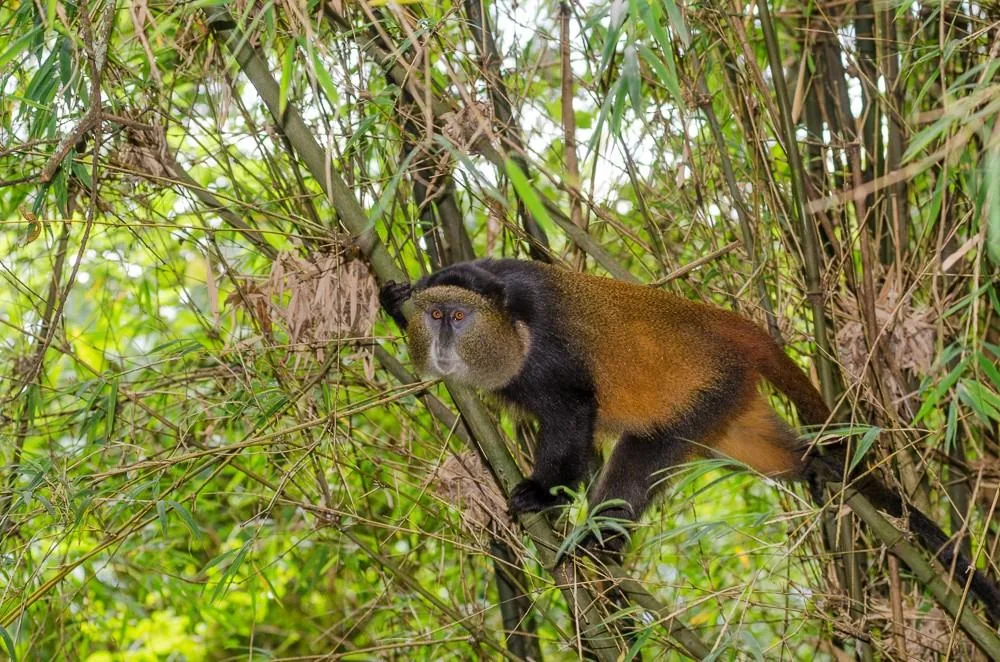
With only about 1,200 left on Earth, Uganda protects more than half of the entire global population. This offers unique trekking experiences in dense montane forests at high elevations, within UNESCO-recognized ecosystems known for incredible biodiversity and conservation success. Visitors need permits for guided treks to see these critically endangered primates.
A Gentle Giant of the Forest
Mountain gorillas live high in the misty forests of Bwindi and the Virunga Mountains. In the wild, they are found only in four protected mountain forests: Bwindi Impenetrable National Park, Mgahinga Gorilla National Park, Volcanoes National Park in Rwanda and Virunga National Park in the Democratic Republic of Congo. Despite their powerful build and massive strength, they are calm, intelligent and deeply social animals. Each gorilla family is led by a dominant silverback whose role is to protect, guide and maintain harmony within the group. Females nurture the young, while juveniles spend their days playing, climbing and learning survival skills.
Gorillas feed mostly on leaves, shoots, bark and wild fruits, spending much of their day foraging and resting. At night, they build fresh nests on the forest floor or in trees, a ritual repeated daily. Gorilla trekking allows visitors to observe these incredible primates in their natural habitat - a rare, emotional experience that creates lifelong memories while supporting conservation efforts.
Sleeping Behavior
Gorillas prepare for the night by making a nest in the trees or on the ground. The heavier silverbacks usually sleep on the ground, while lighter females and young ones normally sleep in trees. Gorillas also build nests for daytime rest. Mothers teach their young how to make a nest. Nests are often built within five minutes and consist of bent or broken branches and leaves. Interestingly, in contrast to eastern and western lowland gorillas, mountain gorillas may foul their nests with droppings. The nests play an important role in the gorilla census. Together with DNA testing of feces, researchers can get a good estimate of the number of gorillas in a given area.
Food
Mountain gorillas are primarily herbivores but also eat fruit, insects and dead wood (because of the presence of sodium). The rainforest is very rich in herbs and other vegetation. Wild celery, lobelia and thistles belong to the daily menu. Virunga gorillas eat about 60 different plant species; Bwindi gorillas about 140. This has to do with the fact that the habitat of the Virunga gorilla is situated at a higher altitude which has less vegetation than the lower situated habitat of the Bwindi gorilla.
Life of a Dominant Silverback
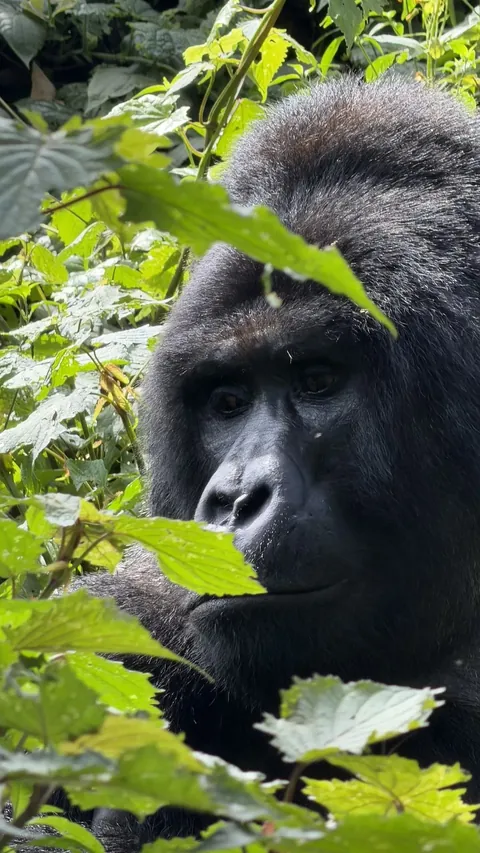
The dominant silverback is the absolute leader of the group. Any form of disobedience is punished. The development to become the dominant leader is a process that takes years. The position of dominant silverback can be achieved by a mix of maturity, experience and physical strength. Many silverbacks will never get to this dominant position and will have to live a nomadic life alone or live as a subordinate in a group of gorillas. If a silverback takes over the leadership of a group, it does not mean automatically that the other group members accept him as the dominant silverback. It can take months before this happens.
The dominant silverback determines the rhythm of the group. He decides when the group should eat, sleep or rest and when to break up. His appearance is usually sufficient to stop threatening conflicts between members of the group. The subordinate males and females do not want any confrontation with the dominant silverback. When meeting other groups, the dominant male is the one who intimidates with chest-beating, accompanied by a series of vocalizations as roaring, barking and hooting. He protects the group and tries to prevent his females from going over to another dominant silverback.
While fighting within a group is rare, in a confrontation with another group heavy fights can break out. The initial provocation to attack, progressing up to a fight, is an almost ritualized event whereby the silverbacks try to impress each other by their behaviour and vocalisations. Short distances are travelled bipedal, there is plenty of chest-beating, vegetation is thrown, trees are pulled down and branches are broken. This behaviour is usually accompanied by a lot of hooting and growling noises. If the external display doesn't result in discouraging the rival male, a fierce battle inevitably follows whereby the silverbacks attempt to injure each other with their canines. These battles may eventually lead to the death of one of the silverbacks. Silverback skulls are often found with severe damage to the cranium and often with broken canines.
The dominant silverback has the exclusive rights on mating. As soon as a female is ovulating and reaches her peak time, he is the one who has the right to mate with her. By means of possible political considerations, he sometimes permits subordinate males to mate with her. Blackbacks who have reached maturity are often tolerated to stay in the group, but they have no rights at all to mate with the females; hence they are punished severely if they try to do so.
The life of a dominant silverback is not easy. The level of stress in his life is extremely high. The threat of a hostile takeover of his group is constantly lurking and there is always a possibility that females will abandon him. He must protect his children against hostile silverbacks. He must never weaken. The right to copulate takes a heavy toll: silverbacks live shorter lives than female gorillas.
Female Gorilla
Between mother and daughter on the other hand is close and when in trouble they help each other. Female animals can enter alliances to help each other against aggressive males or females. The strongest survival instinct in an adult female is to get as close as possible to the dominant silverback. The dominant silverback provides protection against predators and infanticide, of which the latter is decisive. Females will usually change groups a couple of times during their lifetime.
The first group change happens after the female reaches sexual maturity. She leaves her birth group to avoid incest. Although females are subordinate to the dominant silverback, they have the choice to switch silverbacks. The dominant silverback may still try to prevent this, especially after a change of power (i.e., when a new silverback takes over and females start looking for a new group). In contrast to males, females do not like to roam on their own in their habitat, even if they are accompanied by another female. The urge to be with a silverback is so strong that they always try to join a group as soon as possible.
Although females are subordinate to the dominant silverback, they are not completely powerless. They can influence group dynamics and even challenge the silverback's authority in certain situations. However, such challenges are rare and usually occur only when the silverback is weak or has been replaced by a new dominant male. If a female chooses to join a wandering silverback instead of joining an already existing group, she may be able to find a more suitable environment for herself and her offspring.
Fertility and Birth
As you may have read previously female gorillas usually reach maturity between their sixth and eighth year, but they bear their first young usually around the age of ten. The monthly estrus period takes an average of one to three days. The copulation is usually performed by the dominant silverback and is of short duration, just a few minutes. At the estrus peak of the female, during a certain time there will be a mating every hour. Some females will mate also with other silverbacks in the group in order to secure the future of her young. Indeed, all silverbacks could be the father of her young! The gestation period lasts about 8.5 months, after which usually a single infant is born. Twins are very rare. The birth usually takes place in the forest, hidden from the eyes of other group members. The mother will isolate herself for a couple of days before and after the birth. The infant is born helpless, blind and with a weight of about 1.5 to 2.5 kg. The mother will carry her infant for the first three months constantly on her belly. After that period, the infant will start to cling to the mother's back. The infant will be completely weaned after about three years. The mother will nurse her infant frequently during the first months, but gradually the intervals between nursing will become longer. After weaning, the infant will start to eat solid food, initially assisted by the mother.
Gorilla Life Cycle: From Birth to Death
A mountain gorilla's life begins after roughly eight and a half months of gestation, usually with a single infant. The newborn is small, helpless and completely dependent on its mother. For the first months it is carried against her body, then gradually begins to ride on her back, watch feeding choices and learn the movements of the group.
Infancy and the juvenile years are a long apprenticeship. Young gorillas nurse for years, begin eating solid foods with help and learn through play, touch, climbing, nest building and repeated correction from older group members. This slow development is one reason gorilla populations recover carefully rather than quickly.
As gorillas mature, females usually leave their birth group and later raise one infant at a time with long gaps between births. Young males pass through the blackback stage before the silver hair of adulthood becomes visible. A male may remain subordinate, travel alone, join other males or eventually attract females and become a silverback.
In adulthood, the social life of the group revolves around protection, feeding movement, mating access and family stability. A strong silverback can hold the group together for years, while adult females make choices that shape the group's future through transfers, alliances and care for young.
Old age changes the balance slowly. Teeth wear, old injuries stiffen, strength fades and rivals may test a weakening silverback. In the wild, gorillas commonly live several decades and death may come through age, illness, injury, conflict or the pressures of a changing group. Because births are single, care is long and surviving offspring are few, every birth and every adult life matters to the future of the forest population.
Infancy, Play and Learning
The first years of a mountain gorilla's life are carried on the body of its mother. At first the baby is almost always against her chest, listening to her breathing, feeling when she moves and learning the rhythm of the group before it can move confidently on its own. Later it rides on her back, peering over her shoulders as the family feeds, rests and travels through the forest.
A young gorilla learns by touching everything. It tastes stems its mother has chosen, pulls at leaves, watches older juveniles wrestle and copies the patient business of nest building. Play is not wasted time. The tumbling, chasing, climbing and mock fighting teach balance, confidence, strength and social rules. A careless youngster may be corrected by a mother, an older sibling or the silverback himself, but most lessons are gentle and repeated many times.
Juveniles, Blackbacks and Leaving Home
As the infant becomes a juvenile, the forest opens up. It spends more time away from its mother, but never completely outside the security of the group. Young gorillas test branches, race through vegetation and learn which adults are tolerant and which ones deserve space. In these years personality becomes visible: some are bold and theatrical, others cautious, playful or quietly attached to one favorite relative.
Young males eventually enter the blackback stage, when the body is strong but the silver saddle has not fully developed. This is an unsettled age. A blackback may remain as a subordinate, act as a watcher at the edge of the group or eventually leave to travel alone or with other males. For many males, adulthood begins with uncertainty: long days without the protection of a family, cautious approaches to other groups and the difficult work of attracting females before he can become a true leader.
Communication and Emotions
Gorilla life is full of quiet language. A relaxed grunt can keep the family connected while feeding in thick vegetation. A cough-bark may warn others that something is wrong. Chest-beating, hoots, charges, postures and branch-dragging can look frightening, but often they are messages before they are fights. The goal is usually to avoid injury by making strength visible.
Their softer communication is just as important. Gorillas touch, groom, sit close and use facial expressions that make the group feel less like a crowd and more like a household. Mothers comfort infants. Juveniles invite play. Adults can show anxiety, irritation, calm, curiosity and grief. When a group loses a member, the silence around that absence can be as powerful as any display.
Old Age and the End of a Reign
A mountain gorilla can live for several decades in the wild and age changes the story slowly. An older female carries knowledge of feeding places, safe routes and social history. An older silverback may still command respect, but every year asks more of his body. His canines wear, old wounds stiffen and younger males begin to measure him more carefully.
If the silverback weakens, the whole group feels it. Females may transfer, rivals may approach and young gorillas become vulnerable if protection breaks down. Sometimes leadership passes through conflict, sometimes through gradual change. Either way, the life of one silverback is tied to the safety, movement and future of many others.
Why Every Birth Matters
Mountain gorillas reproduce slowly. A female usually raises one infant at a time and may wait several years before the next birth. This makes every baby precious and every loss difficult for the population to replace. Conservation success in Uganda, Rwanda and the wider Virunga region has come because forests are guarded, snares are removed, tourism is controlled and communities around the parks have a reason to keep gorillas alive.
To meet a mountain gorilla in the forest is therefore not just to see a rare animal. It is to step briefly into a family story that began before you arrived and will continue after you leave: a mother teaching her infant, a juvenile discovering its strength, a silverback carrying the burden of leadership and a forest whose future depends on how carefully people choose to move through it.